
Applied science leadership · Amazon AGI
Ankit Chadha
Director of Applied Science at Amazon AGI.
I lead science and engineering teams building grounded reasoning for AI agents, agent memory, and web-scale retrieval across text, images, and structured data.
I lead Applied Science and Engineering teams at Amazon AGI, turning research in foundation models and agents into systems that work at web scale. My work spans post-training and alignment, multimodal and grounded retrieval, agent memory, and evaluation. A recurring question connects it: how can an AI system find reliable evidence, reason over it, and retain useful experience? Previously I led deep learning work at Salesforce and worked at Apple and Samsung.
Agents that reason from evidence.Grounded reasoning across text, images, and structured data, supported by memory, web-scale retrieval, and long-horizon planning.
Research that reaches real systems.Turning advances in post-training, alignment, and evaluation into reliable AI systems that operate at web scale.
A sustained publication record.Peer-reviewed work across ACL, NAACL, CIKM, INTERSPEECH, and ECML PKDD, with additional work at NeurIPS workshops.
Selected research contributions
Counts are what Google Scholar reported on 2026-09-15. The live numbers are on my Scholar profile.
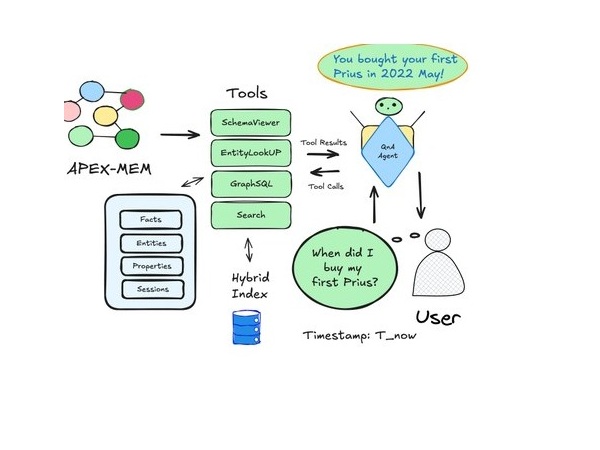
APEX-MEM: Agentic Semi-Structured Memory with Temporal Reasoning for Long-Term Conversational AI
Pratyay Banerjee, Masud Moshtaghi, Shivashankar Subramanian, Amita Misra, Ankit Chadha
APEX-MEM uses an append-only property graph of temporally grounded, entity-centric events and a multi-tool retrieval agent to resolve evolving information at query time.
Research contributionIntroduced an append-only property graph memory that represents conversations as temporally grounded, entity-centric events and resolves evolving information at retrieval time.
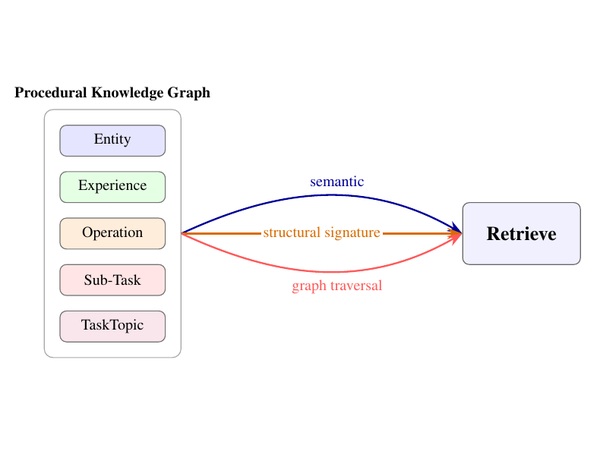
APEX-EM: Non-Parametric Online Learning for Autonomous Agents via Structured Procedural-Episodic Experience Replay
Pratyay Banerjee, Masud Moshtaghi, Ankit Chadha
APEX-EM introduced procedural knowledge graphs for LLM agent memory: its typed Procedural Knowledge Graph stores complete solution traces and retrieves them by meaning, operation structure, and graph traversal, with no model retraining.
Research contributionIntroduced procedural knowledge graphs for LLM agent memory through a typed Procedural Knowledge Graph, procedural-episodic experience replay, and cross-domain structural retrieval.
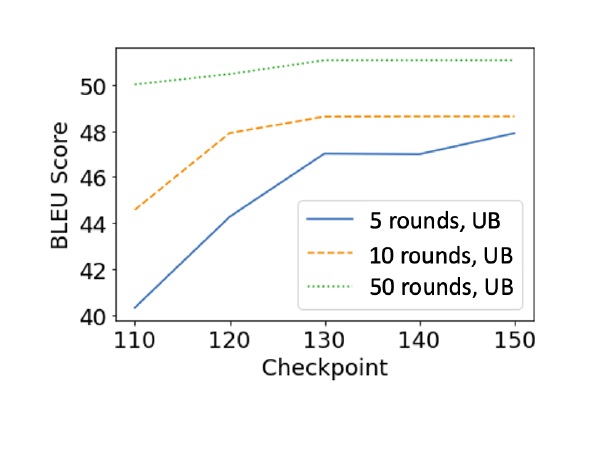
Training Mixed-Domain Translation Models via Federated Learning
Peyman Passban, Tanya Roosta, Rahul Gupta, Ankit Chadha, Clement Chung
Five domain-specific translation models use federated learning to build a mixed-domain neural machine translation system without pooling their data, with a method for selecting impactful parameters to control communication bandwidth.
Research contributionIntroduced a federated approach to mixed-domain neural machine translation and a bandwidth-control method that selects impactful parameters during federated updates.
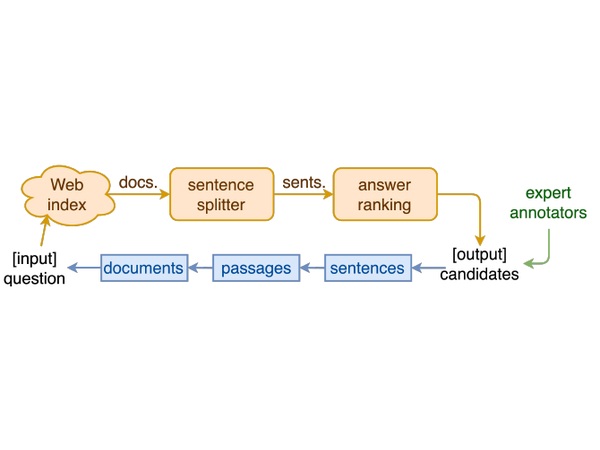
WDRASS: A Web-scale Dataset for Document Retrieval and Answer Sentence Selection
Zeyu Zhang, Thuy Vu, Sunil Gandhi, Ankit Chadha, Alessandro Moschitti
WDRASS introduced a web-scale open-domain question answering dataset with 64,000 questions and 800,000+ labeled passages and sentences drawn from 30 million documents.
Research contributionIntroduced a web-scale dataset that connects document retrieval, passage reranking, and answer sentence selection using complete sentence-level answers rather than short answer matching.
All 13 papers, with abstracts and numbers →
Research and systems
- Agent memory2026
2 papersCurrent -
Introduced typed procedural knowledge graphs for reusable agent experience and append-only property graph memory for temporal conversational reasoning.
- APEX-MEM: Agentic Semi-Structured Memory with Temporal Reasoning for Long-Term Conversational AIACL 2026 (Main Conference, Long Papers)+3.5 pp on LOCOMO
- APEX-EM: Non-Parametric Online Learning for Autonomous Agents via Structured Procedural-Episodic Experience ReplayEMNLP 2026, accepted, to appear+31.7 pp on KGQAGen-10k
- How agents delegate2026
1 paper -
Introduced adaptive routing between typed dependency graphs and natural-language handoffs for multi-agent LLM systems.
- Routed Graph Handoff: Adaptive Format Selection for Multi-Agent LLM DelegationEMNLP 2026, accepted, to appear+12.7 pp on τ-bench retail
- Web-scale question answering2022–2023
4 papers -
Built web-scale document retrieval, passage reranking, and answer sentence selection methods spanning thirty million documents and nine languages.
- WDRASS: A Web-scale Dataset for Document Retrieval and Answer Sentence SelectionCIKM 2022+9.6 pp on WDRASS
- Cross-Lingual Knowledge Distillation for Answer Sentence Selection in Low-Resource LanguagesFindings of ACL 2023+12.1 pp on Xtr-WikiQA, Arabic
- Question-Context Alignment and Answer-Context Dependencies for Effective Answer Sentence SelectionINTERSPEECH 2023+6.07 pp on WikiQA
- Efficient Fine-Tuning Large Language Models for Knowledge-Aware Response PlanningECML PKDD 2023 (Research Track), LNAI 14170+5.1 pp on WikiQA
- Learning from data that cannot move2021–2022
2 papers -
Developed mixed-domain neural machine translation and communication-efficient federated learning without pooling data across domains.
- Training Mixed-Domain Translation Models via Federated LearningNAACL 2022 (Main Conference)+1.83 BLEU on German to English
- Communication-Efficient Federated Learning for Neural Machine TranslationNeurIPS 2021 ENLSP Workshop+1.06 BLEU on Federated translation
- Steering what a model says2022–2023
2 papers -
Developed methods for controlling toxicity, sentiment, simplicity, and viewpoint through hidden-state transformations and attribute conditioning.
- Controlled Text Generation with Hidden Representation TransformationsFindings of ACL 2023-0.74 toxicity on RealToxicityPrompts
- ACM -- Attribute Conditioning for Abstractive Multi Document SummarizationarXiv preprint+7.13 on MultiNews
Experience
- 2021 – now
Director of Applied ScienceAmazon, Amazon AGI
Lead a team of scientists and engineers on grounded, multimodal language model systems: knowledge graphs, web and multimodal search, retrieval and agentic retrieval, and the post-training and evaluation behind them.
- 2020 – 2024
Advisor, AI programStanford Center for Professional Development
Advised on Stanford's professional AI courses XCS221, XCS224N and XCS224U.
- 2019 – 2021
Senior Manager, Deep Learning Research and EngineeringSalesforce
Built and led the team behind Einstein Intent, Einstein NER and Einstein Sentiment, the language understanding under Einstein Bots.
- 2016 – 2019
Previous companiesSamsung R&D America, Apple
Education
- MS, Computer EngineeringUniversity of Minnesota, Twin Cities
- Graduate AI coursework, CS221, CS224n, CS231n, CS234Stanford University